
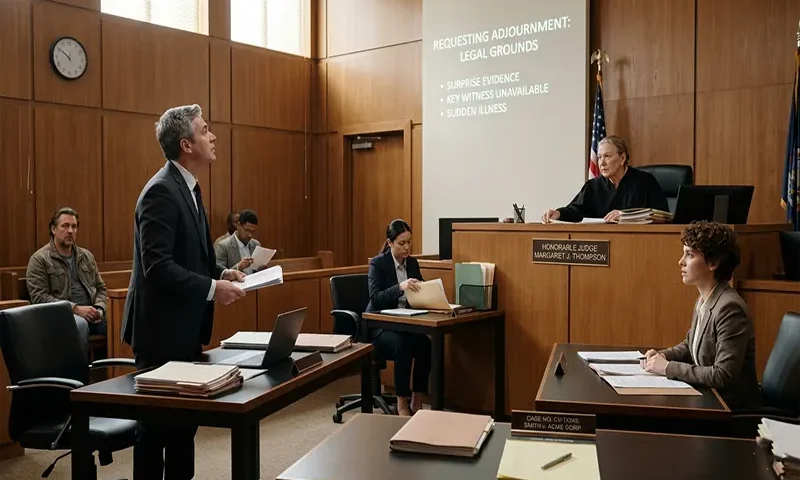
In the legal world, the phrase “justice delayed is justice denied” is more than a cliché; it is the guiding principle of the judiciary. Judges are tasked with moving cases through the system efficiently, which means they generally view requests for adjournment—formally known as a “motion for continuance”—with significant skepticism. However, life is unpredictable, and legal systems recognize that there are instances where a hearing cannot proceed as scheduled.
If you find yourself needing to request an adjournment for a civil court hearing, it is vital to understand that this is a privilege granted by the court, not a right. Success depends entirely on your ability to demonstrate “good cause.”
Valid Legal Grounds for Adjournment
A request for an adjournment must be rooted in circumstances that are beyond your control and that prevent you from effectively participating in the hearing. Common grounds accepted by courts include:
- Medical Emergencies: A sudden, documented illness or injury that renders you physically or mentally unable to attend court is generally considered good cause. You will be expected to provide a physician’s note that clearly states the nature of the incapacity and the anticipated duration of the recovery.
- Conflict with Prior Court Orders: If you have been ordered to appear in a different court at the exact same time as your civil hearing, this is a valid conflict. Courts prioritize other court dates, but you must provide proof of the conflicting summons or order.
- Unavailability of Essential Witnesses: If a witness who is critical to your case—such as an expert or someone who witnessed the incident—is subpoenaed but unable to attend due to a legitimate, unavoidable conflict (e.g., military deployment or medical surgery), the court may grant a continuance to ensure the case is fully heard.
- Lack of Proper Notice: If you were not served with the court documents in a timely manner according to your jurisdiction’s rules of civil procedure, you have not had an adequate opportunity to prepare your defense. This is a common and valid ground for requesting more time.
- Imminent Change in Legal Representation: If your attorney has recently withdrawn from the case or if you have just retained new counsel, the court may grant an adjournment to allow the new attorney time to review the file and provide you with competent representation.
The Procedural Process
Courts operate on strict procedural rules. If you do not follow them, your motion for continuance will likely be denied without even being read.
The Motion for Continuance
You cannot simply call the clerk and ask to move your date. You must file a formal written document, known as a “Motion for Continuance.” This motion must be filed with the court and served to the opposing party.
The “No-Surprise” Rule
Timeliness is critical. You must file your motion as soon as you become aware of the conflict. Filing a motion on the morning of the hearing, without extraordinary circumstances, is often viewed as disrespectful to the court and the opposing counsel, and is frequently denied.
Conferring with Opposing Counsel
Before filing your motion, you are typically required to speak with the opposing party or their attorney. Ask them if they object to your request. If they consent to the adjournment, the judge is much more likely to grant it. If they object, you must be prepared to explain to the judge why your need for an adjournment outweighs the prejudice (harm or delay) caused to the other party.
What is NOT Good Cause
Judges are not swayed by inconvenience. The following reasons are almost never accepted as good cause:
- “I forgot” or “I was busy”: These suggest a lack of respect for the court.
- Vacations: Unless a vacation was booked and paid for before you received notice of the hearing, the court will expect you to prioritize your legal obligations.
- Unpreparedness: If you had months to prepare and chose not to, the court will generally force you to proceed, even if you are not ready.
The Anatomy of a Motion
Your motion should be concise and professional. It must include:
- Case Information: The case name, index number, and the scheduled hearing date.
- The Reason: A clear, factual statement explaining why the adjournment is necessary.
- The Proof: Attached documentation, such as medical letters, conflicting court orders, or travel itineraries (if applicable).
- Proposed New Dates: Provide the court with dates when you and your witnesses are available, demonstrating that you are working toward resolution rather than simply stalling.
Critical Warning: Never assume your request will be granted. The mere act of filing a motion does not stop the hearing from occurring. You must continue to prepare for the original hearing date until you receive a signed order from the judge explicitly granting the adjournment and canceling the appearance. If you do not attend and the judge denies your motion, you may face a default judgment or other severe penalties.
Requesting an adjournment is a serious step that requires transparency, proper documentation, and respect for the court’s time. Your motion is an argument that the interests of justice—which require you to be present and prepared—are better served by delaying the proceedings. Approach the process with this professional mindset, and you increase your chances of securing the time you need to ensure your case is heard fairly.

