
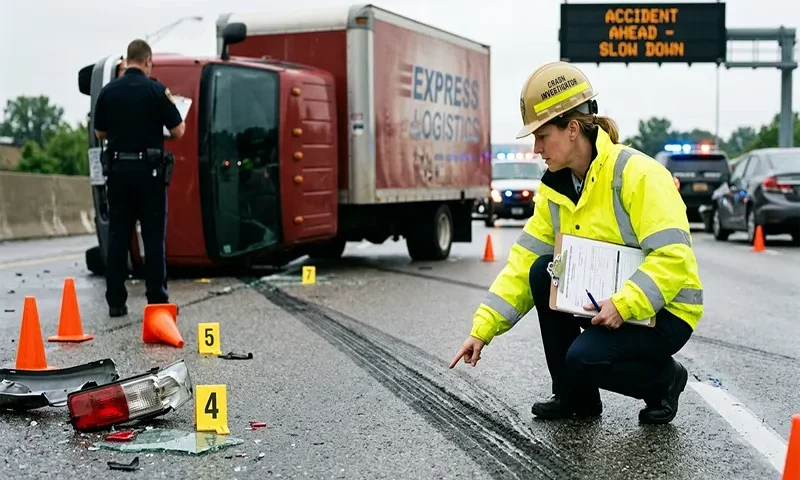
Commercial delivery vehicles—from heavy semi-trucks to the growing fleet of “last-mile” delivery vans—are ubiquitous in our modern economy. However, their presence on public roads introduces significant risks. When a collision occurs, the process of proving liability is vastly different from a typical passenger car accident. Because these drivers are acting as agents for a business, and because commercial vehicles are governed by both state law and stringent federal regulations, establishing fault requires a methodical, evidence-based approach.
The Investigative Foundation: Why Data Matters
Unlike a standard fender-bender, a commercial crash requires an immediate and aggressive investigative response. In the world of trucking litigation, evidence is fragile and often controlled entirely by the defendant.
Electronic Logging Devices (ELDs) & Telematics
Modern delivery vehicles are essentially mobile computers. Most are equipped with “black boxes” or Electronic Logging Devices (ELDs) that record precise data points in the moments before, during, and after an impact. This telematics data is the “smoking gun” of liability; it provides irrefutable evidence of:
- Speed: Whether the driver was exceeding the speed limit.
- Braking Patterns: Whether the driver performed an emergency stop or failed to brake entirely.
- GPS Data: The route taken and whether the vehicle was operating on unauthorized roads.
Driver Qualification Files
A commercial driver is only as safe as their training and background allow. Attorneys specializing in this field will demand the driver’s “Qualification File.” This file reveals whether the company performed mandatory background checks, verified the driver’s commercial license, and provided necessary training. If a company knowingly hired a driver with a history of safety violations, it opens a path for a claim of “negligent entrustment.”
Maintenance Records
A crash is often not the result of driver error, but of corporate neglect. Maintenance records can prove that a vehicle was being operated with known defects—such as faulty brakes, bald tires, or broken lighting systems. Proving that a delivery company skipped mandatory service intervals is a powerful way to establish institutional liability.
Establishing Negligence: The Legal Standard
To win a case, a plaintiff must prove the four classic elements of negligence within the context of the commercial transportation industry:
- Duty of Care: Every driver has a duty to operate their vehicle safely. Commercial drivers are held to a higher standard of care because of their specialized training and the sheer size of their vehicles.
- Breach: The driver or company failed to uphold that duty—by speeding, violating Hours of Service (HOS) regulations, or failing to maintain the truck.
- Causation: The breach directly caused the collision.
- Damages: The collision resulted in quantifiable harm, such as medical bills, lost wages, or permanent injury.
The “Vicarious Liability” Angle
One of the most critical aspects of commercial delivery accidents is the doctrine of respondeat superior, or vicarious liability. This legal principle holds that an employer is responsible for the actions of their employees when those actions occur within the scope of their employment.
When a delivery driver causes a crash, the target of the litigation is rarely just the driver; it is the deep-pocketed delivery company. Naming the employer is essential, as these entities carry significantly higher insurance policy limits, which are necessary to cover the often catastrophic damages associated with heavy vehicle collisions.
Legal Insight: There is a distinct difference between “driver error” and “corporate compliance failure.” Driver error (e.g., a distracted moment) makes the driver liable. Corporate compliance failure (e.g., forcing a driver to work beyond HOS limits to meet delivery quotas) makes the company directly liable for its own systemic negligence.
Common Scenarios of Liability
- Driver Fatigue: The trucking industry is notorious for high-pressure delivery schedules. If your attorney can access logs that show a violation of Hours of Service (HOS) regulations, they can prove that the driver was likely operating the vehicle in a state of impairment due to exhaustion.
- Distracted Driving: Delivery drivers are often managing GPS systems, delivery apps, and communication from dispatchers simultaneously. Phone records and in-cab surveillance footage are frequently used to demonstrate that the driver’s attention was not on the road.
- Improper Load/Maneuvering: Delivery vehicles often have high centers of gravity. Improper loading can make a vehicle unstable, leading to rollovers or an inability to stop in time. Liability in these instances often rests with the warehouse or loading-dock staff who failed to follow safety protocols.
Proactive Evidence Collection
“Proof” in a commercial vehicle case is a proactive race against time. Because evidence like telematics data or maintenance logs can be purged, overwritten, or “accidentally” lost, it is standard practice for a specialized attorney to issue a spoliation letter immediately following an accident. This legal document puts the delivery company on notice that they must preserve all evidence related to the crash. Failure to do so can result in severe legal sanctions against the company, which often helps the plaintiff’s case significantly.
Proving liability in a commercial delivery crash is not just about what happened on the road—it is about what happened in the dispatch office, the maintenance bay, and the training room. Because delivery companies are incentivized to protect their reputations and financial interests, they will often move quickly to minimize their involvement.
If you are involved in a collision with a commercial delivery vehicle, recognize that you are entering a complex arena of corporate insurance defense. Securing the representation of an attorney who understands the nuances of ELD data, federal safety regulations, and corporate liability protocols is not just an option—it is a necessity to ensure that the full truth of the collision is brought to light and that you receive the compensation you deserve.

