
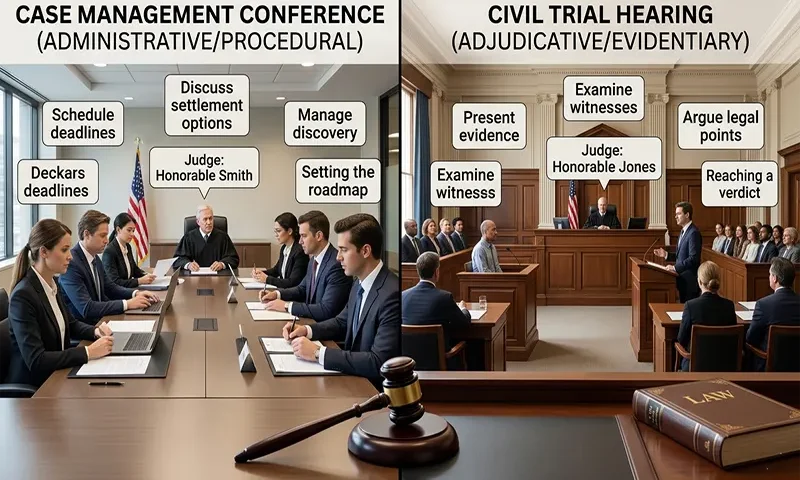
Navigating the civil litigation process can feel like learning a new language. For those unfamiliar with the legal system, the terminology used by court clerks and attorneys often sounds interchangeable, yet the procedural differences between these events are significant. Two of the most common—and most distinct—milestones in a lawsuit are the Case Management Conference (CMC) and the Civil Trial Hearing. Understanding the purpose, setting, and expectations of each is essential for anyone involved in a civil dispute.
Understanding the “Roadmap” of Litigation
Civil litigation is not a single, isolated event; it is a marathon of procedural steps designed to move a dispute from an initial filing to a final judgment. Courts use various types of meetings to keep this process on track. Think of the litigation process as a roadmap: the Case Management Conference is the planning session where you determine the route and the timeline, while the Civil Trial Hearing is the destination where the actual resolution is reached.
Case Management Conference (CMC) Explained
A Case Management Conference is essentially the “business meeting” of a lawsuit. Its primary purpose is not to decide who wins or loses, but to ensure that the case progresses efficiently toward a resolution.
- The Purpose: At a CMC, the judge and the attorneys meet to discuss the “logistics” of the case. This includes setting deadlines for discovery (the exchange of evidence), determining whether the parties are interested in mediation or settlement, and identifying any specific legal issues that need to be resolved before the trial can begin.
- The Atmosphere: A CMC is typically informal. It is often held in the judge’s chambers or via a virtual conferencing platform like Zoom. Because the goal is management rather than adjudication, the atmosphere is collaborative rather than adversarial.
- Who Is Involved: Generally, the judge and the attorneys for each side are the primary participants. While parties are sometimes welcome, they are often not required to speak, as the focus remains on legal strategy and scheduling.
Civil Trial Hearing Explained
A Civil Trial Hearing is the “main event.” It is a formal, adversarial proceeding where the evidence is presented to a judge or jury to reach a final verdict.
- The Purpose: The goal here is adjudication. Each side presents witnesses, introduces physical evidence, and offers legal arguments to prove their case. The hearing concludes with a ruling, a judgment, or a verdict that officially decides the outcome of the dispute.
- The Atmosphere: A trial hearing is highly formal. It takes place in a courtroom, follows strict rules of evidence, and is recorded by a court reporter. Participants are expected to adhere to specific protocols, such as standing when the judge enters and addressing the court only when permitted.
- Who Is Involved: The judge (or jury), the attorneys, witnesses, court staff, and often the public, as trials are generally open to the public.
Key Differences at a Glance
| Feature | Case Management Conference (CMC) | Civil Trial Hearing |
| Primary Goal | Scheduling, logistics, & discovery | Adjudication & final verdict |
| Formality | Informal/Administrative | High/Strictly formal |
| Evidence | Not presented/discussed | Presented & examined strictly |
| Outcome | Court orders regarding deadlines | Final judgment or ruling |
| Primary Actors | Judge & Attorneys | Judge/Jury, Attorneys, & Witnesses |
Why the Distinction Matters
Mistaking a CMC for a trial hearing—or vice versa—can be disastrous for a participant. If a party shows up to a Case Management Conference with witnesses and evidence boards, they will find themselves in a meeting where no one is prepared to hear testimony. Conversely, if a party shows up to a Trial Hearing expecting an informal discussion about scheduling, they will be utterly unprepared for the rigors of cross-examination and evidentiary rules.
Pro-Tip: Always ask your attorney, “What is the expected outcome of this specific hearing?” Before any court date, confirm whether you are expected to bring evidence, whether witnesses are required to testify, or if your role is simply to observe the procedural updates.
A Note on Legal Terminology
- Discovery: The formal process of exchanging information, documents, and witness statements between opposing parties. This is the “fact-finding” phase that is heavily managed during a CMC.
- Adjudication: The process of a court considering evidence and arguments to reach a final, binding decision. This is the sole focus of a trial.
The distinction between a Case Management Conference and a Civil Trial Hearing is the difference between planning a journey and taking the journey itself. A CMC sets the rules, the timeline, and the boundaries of the litigation, while the Trial Hearing is the courtroom battle where the truth is weighed and a final determination is made. By understanding the unique role each event plays in the life of your case, you can better prepare yourself for the requirements of each phase, reducing uncertainty and ensuring that you are ready whenever the judge calls the court to order.

