
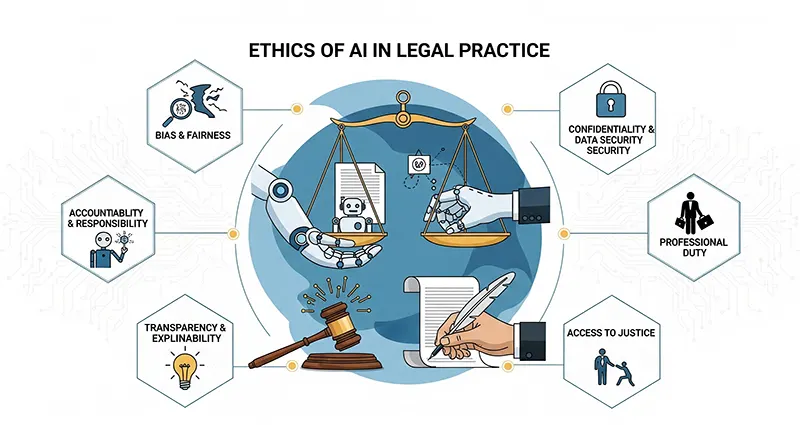
Malang, with its dynamic economic growth and legal sector, has not escaped the wave of technological revolution. Advocates and law firms in the city are increasingly adopting Artificial Intelligence (AI) to improve efficiency, from document review to legal research. However, along with its tremendous benefits, the use of AI in legal practice raises a series of crucial ethical considerations that legal professionals must understand and address.
These ethical considerations are not only globally relevant, but also have important implications in the Indonesian legal and cultural context, especially under guidelines such as the Circular Letter of the Minister of Communication and Informatics Number 9 of 2023 concerning the Ethics of Artificial Intelligence .
Following are some of the main ethical considerations that advocates in Malang should pay attention to:
Client Confidentiality and Personal Data Protection
One of the most fundamental ethical obligations for an advocate is to maintain the confidentiality of client information. When sensitive client data is input into an AI platform, especially one operated by a third party, there is a risk of data leakage.
- Challenge: Generative AI platforms often use user-inputted data to train their models. Without a strict privacy policy, confidential client information could be exposed.
- Solution: Advocates must ensure that the AI platforms they use have robust security and privacy policies. They should choose tools specifically designed for legal practice with clear confidentiality guarantees and, if necessary, obtain client consent to use third-party platforms. In Indonesia, this aligns with the Personal Data Protection Law (PDP Law), which requires accountability in data processing.
Accuracy, Bias, and Accountability
AI can produce answers and analyses at incredible speed, but this doesn’t mean its results are always perfect. “Hallucinations” or factual errors generated by generative AI are a real risk. Furthermore, if the AI’s training data contains historical biases (for example, gender or racial bias), its output could inadvertently replicate or even exacerbate those biases.
- Challenge: Advocates should not blindly rely on AI output without verification. If an incorrect legal argument is presented in the Malang District Court due to AI error, the advocate is responsible.
- Solution: Advocates must maintain their role as the final “arbiter.” Every AI output, whether draft documents, case summaries, or predictive analysis, must be thoroughly reviewed by a human. Advocates have an obligation to ensure that all claims and arguments presented to the court are valid and legally sound.
Technological Competence and Professional Skills
Ethical rules for advocates, including those in Indonesia, require them to provide competent representation. In the digital age, this includes an adequate understanding of the technology used in their practice.
- Challenge: Lack of understanding of how AI works, its capabilities, and its limitations can lead to unethical or ineffective use.
- Solution: Advocates must proactively improve their technological competency. This can be done through ongoing training, workshops, or collaboration with technology experts. They must understand that AI is a tool, not a substitute for an advocate’s judgment, intuition, and empathy—abilities that machines cannot replicate.
Transparency and Justice
Advanced AI models are often “black box” models, meaning it’s difficult to understand how the AI reaches its conclusions. In the context of litigation or legal decision-making, this raises issues of transparency and the right to due process.
- Challenge: If a legal or strategic decision is based on AI recommendations, the opposing party has a right to know how those conclusions were reached. If the process is not transparent, this could violate the principle of fairness.
- Solution: Advocates must be able to explain the basis for their arguments, regardless of whether AI is used as an aid. This emphasizes the importance of human input in interpreting and justifying any AI-generated results.
The use of AI in legal practice in Malang offers significant opportunities for efficiency and innovation. However, the successful adoption of this technology depends heavily on legal practitioners’ commitment to upholding ethical standards. AI should be viewed as an intelligent partner, not a substitute. By maintaining client confidentiality, verifying accuracy, enhancing competence, and ensuring transparency, advocates in Malang can harness the power of AI while maintaining integrity and public trust in the legal profession.

